
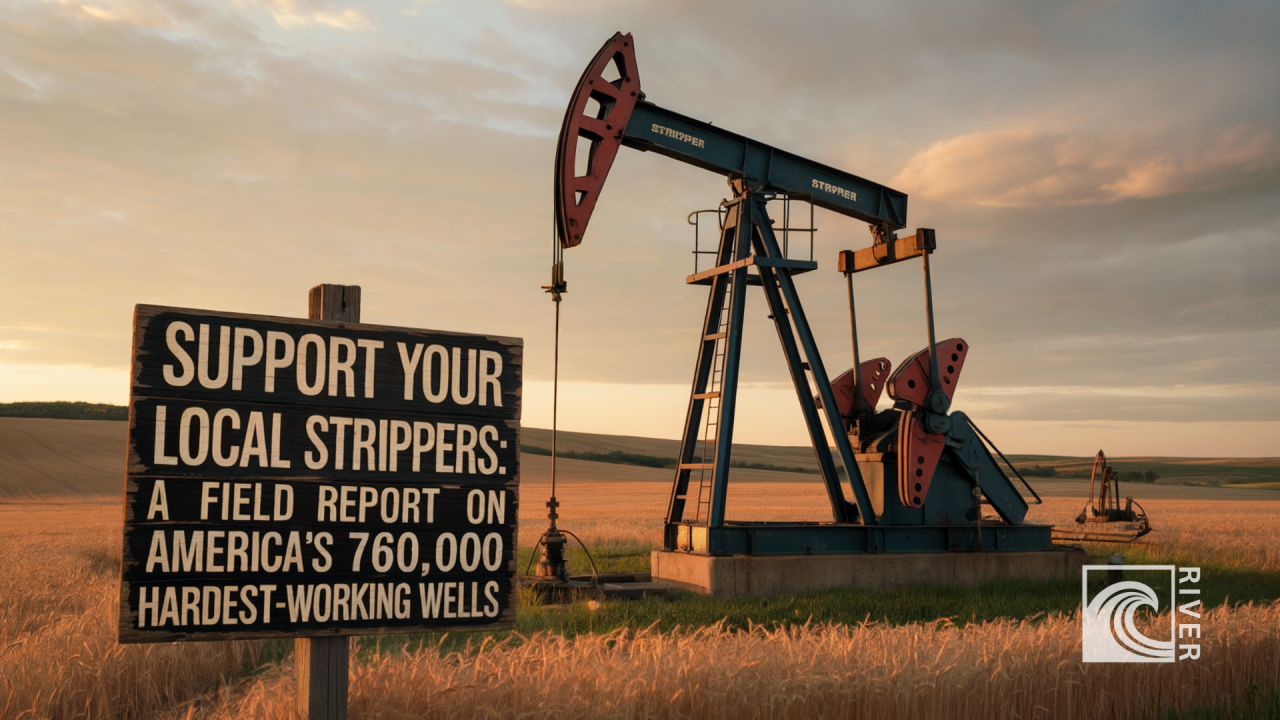
Why 76% of U.S. oil and gas infrastructure runs on pickup trucks, not digital transformation.
Saturday morning, November 1st. Duck season opener in East Texas. 58 degrees and crisp.
I'm riding shotgun with my buddy - an I&E tech doing his side gig. We're visiting 30 strippers across hunting club land. Gunfire echoes through the trees every few minutes. Welcome to American energy infrastructure.
Before HR flags this: stripper wells. The backbone of American energy that nobody in IT knows exists.
What's a Stripper Well?
They're called "strippers" because they're stripping the last remaining oil and gas from nearly depleted reservoirs. Like getting the last bit of peanut butter from the jar - takes more effort for less reward, but still worth doing.
After the easy oil's gone, after the pressure's dropped, after the majors have moved on, stripper wells keep working these tired formations. Using plunger lifts (think mechanical pistons) and soap sticks (literally detergent) to coax out every last MCF.
The technical definition: <15 barrels of oil or <90,000 cubic feet of gas per day. The reality: these wells produce just enough to keep going, year after year, through every boom and bust cycle.
The Reality on the Ground
First well: dirt road, cattle gate secured with a Master Lock. The ABB TotalFlow RTU sits in an unlocked fiberglass enclosure. No password. External connector right there on the cabinet - anyone with a laptop and a serial cable could reprogram the entire flow calculation.
The only sound is the occasional putt-putt-thud of a nearby pumpjack with a missing cylinder. When my buddy opens the valve to check flow, there's a hollow gas hiss like water running through your house pipes. When he pulls the orifice plate for inspection, the vented gas smells exactly like WD-40 - sweet, light petroleum. Your hands get this greasy kerosene film. If they're using soap sticks for lift, add a hint of Dawn dish detergent.
This is energy production in America: hunting clubs, dirt roads, and $5,000 computers protected by literally nothing.
The Infrastructure IT Never Sees
Here's what I discovered visiting 30 stripper wells in Louisiana:
Every single well had:
- ABB TotalFlow RTU (Remote Terminal Unit) - $5,000 each
- Full SCADA capability
- Cellular/radio ready
- Ethernet ports
- Modbus protocols configured
- Completely offline
- By choice
- For 40+ years of profitable operation
Every single well was:
The Architecture That Actually Works
My friend's setup: his personal RAM 1500, toolbox in the back seat, calibrator in a Pelican case, laptop he's borrowing from his day job.
He's a contractor - an I&E tech who does measurement and calibration for dozens of different operators. No company email, no VPN, no corporate IT policies. Just a guy with specialized knowledge, expensive calibration equipment, and a truck that smells like crude oil and coffee.
At each well, the routine:
- Pop the unlocked enclosure (wasps fly out)
- Brush off the spider webs from the M12 connector
- Hook up serial cable with an Ethernet adapter held together with electrical tape
- Wait for PCCU software to load (Windows 7, because if it ain't broke...)
- Check differential pressure across the orifice plate
- Verify against the Crystal calibrator
- Take photos of the screen for later transcription
- Move on to the next well
15 minutes per well if the wasps cooperate. 30 if you need to calibrate. Hour drive between some wells on lease roads that would destroy a Tesla.
This is sophisticated measurement and control - AGA-compliant flow calculations, temperature compensation, the works. They just refuse to put it on any network. The data stays in that box until someone physically shows up to retrieve it.
The Numbers That Matter
76% of all U.S. wells are strippers:
- 760,000 wells total
- 160,000 jobs supported
- 7% of total U.S. production
- $45 million/day in domestic energy
- Average stripper well revenue: barely covers operating costs
- Cellular connectivity: significant chunk of gross revenue
- Security monitoring: another monthly subscription
- Ransomware recovery: could wipe out years of profit
The economics are brutal:
Do the math. Remote monitoring would eat most of the gross revenue before you factor in security, maintenance, and management overhead.
The Security Architecture By Accident
These wells have achieved what every CISO dreams about:
- Zero attack surface (not connected = not hackable)
- Perfect access control (physical presence required)
- Immutable audit trail (paper reports)
- No IT dependencies (runs during any cyber event)
While Fortune 500 companies spend millions on "Zero Trust Architecture," Jimmy's stripper well has achieved actual zero trust: he trusts zero networks because he has zero networks.
While Chevron spends millions on Zero Trust Architecture and air-gapped networks and security monitoring, stripper well operators achieved perfect isolation by being too poor to connect.
Fortune 500 CISOs spend their careers trying to prevent lateral movement between zones. Stripper wells solved it with a Master Lock and no cellular plan.
The unintentional security posture of poverty has beaten the intentional security architecture of wealth for 40 consecutive years.
The Uncomfortable Truth
Energy Transfer (the pipeline company) has cellular modems at their custody transfer points. They could mandate connectivity from producers. They don't.
Why? Because manual monthly reads from 760,000 stripper wells have worked for 40+ years through:
- Multiple nation-state cyber campaigns
- Every ransomware variant
- The SolarWinds hack
- The Colonial Pipeline shutdown
Not one stripper well has ever been ransomwared. Not one has contributed to a cyber-induced shortage.
What Vendors Get Wrong
Last year at an industry conference, I watched a vendor demo their "Intelligent Well Monitoring Platform" - $500/month per well, requires IT department approval, needs VPN configuration, Azure subscription, and a security team review.
For context: that's potentially more than the well produces in a month. To monitor something that's worked fine on monthly truck rolls since 1980.
The vendors are solving the wrong problem. These wells don't need digital transformation - they need to be left alone.
The Trail Cam Problem Nobody's Solving
Here's what drives me crazy: We have cheap cellular trail cams that send photos when deer walk by. They solved remote monitoring for $100-200. Solar powered. Store locally, transmit selectively. Work on terrible cellular. Zero subscription for many models.
When a stripper well DOES justify remote monitoring - maybe it's producing enough, maybe there's a safety requirement, maybe regulatory compliance demands it - the model should be trail cams, not enterprise SCADA:
What trail cams got right:
- Exception-based reporting (not continuous polling)
- Store-and-forward (works through cellular outages)
- Solar powered (no infrastructure dependencies)
- One-time purchase or minimal subscription
- No IT department required
- $500/month platforms
- Continuous data transmission
- Azure subscriptions required
- VPN configurations
- IT approval processes
What oil & gas vendors are still pushing:
The trail cam manufacturers solved remote monitoring in harsh, remote conditions with spotty connectivity. They proved you can build reliable, simple, appropriate technology that works.
But oil & gas vendors are still trying to sell enterprise platforms that cost more than the wells produce.
The technical problem was solved. The business model is the barrier.
What These Wells Actually Need: Nothing
The right architecture for a stripper well is:
- Economic viability (if it stops producing, shut it in)
- Safety compliance (H2S monitors, whatever regulations require)
- Physical access control (appropriate to actual threat model)
- Offline operation (the security posture of non-existence)
Notice what's not on that list: enterprise IT solutions, security monitoring, or connectivity mandates.
These wells prove that "doing nothing" can be the right architecture when the economics, threat landscape, and operational requirements all align.
The vendor community hates this because you can't sell subscriptions to "leave it alone." But 760,000 wells don't care about vendor revenue models.
The Lesson
Saturday morning, duck season opener, I watched America's energy infrastructure working exactly as designed. No IT department. No cloud platform. No ransomware. Just a guy with a truck, checking wells between gunshots.
760,000 wells prove the best cybersecurity might just be a locked gate and no WiFi password to forget.
If it's not connected, it can't be infected.
Support your local strippers. They're keeping your lights on with clipboards and Copenhagen, asking for nothing but to be left the hell alone by IT.
Standing in a field, smelling crude oil and gunpowder, watching $5,000 RTUs run offline by choice - when did we decide every piece of infrastructure needs an IP address?
#StripperWells #IndustrialIndependence #OTSecurity #DigitalTransformation #SCADA #DuckSeason