This isn't a prediction of what might happen. This is an autopsy of what just did.
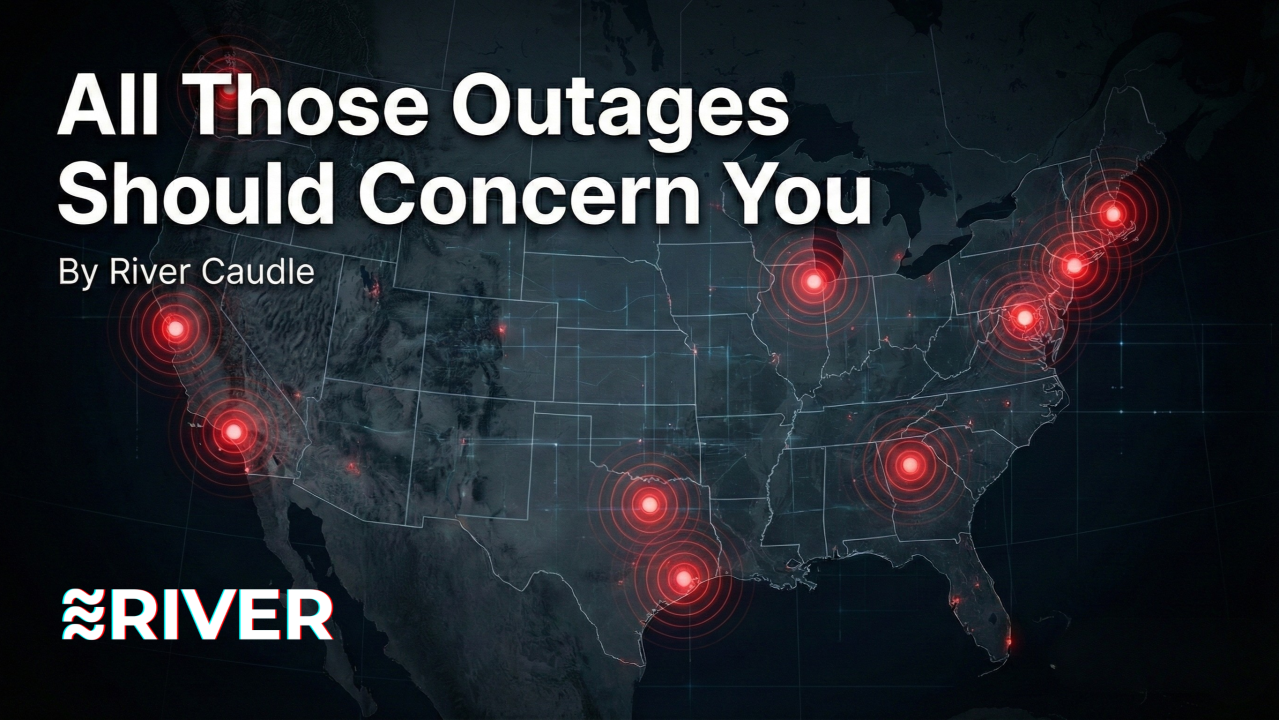
Between January 13 and 22, 2026, the digital bedrock of American infrastructure failed eight times. Telecommunications, cloud identity, social signaling, and financial rails all took a knee.
The statisticians will tell you this cluster exceeds baseline failure rates by 340%. The probability of this happening randomly is roughly 0.03%.

But the corporate press releases are telling a different story: Software bugs. Configuration errors. Coincidence.
If you run critical infrastructure, you don't have the luxury of believing in coincidences that defy math. While Washington is quiet and the C-suites are issuing apologies, the operational reality is screaming. We just watched a stress test of the national grid's digital dependencies, and we nearly failed.
The Timeline Nobody's Connecting
Here's what occurred in a single 10-day window:
Three outages within six hours on January 13. The largest telecommunications outage in recent history on January 14. Back-to-back Microsoft 365 failures affecting security products on January 21-22.
The baseline for major consumer-facing outages (50,000+ reports) is approximately 1-2 per month. We saw eight in ten days.
The Technical Layer: What "Load Balancing Failure" Actually Means
Microsoft's January 22 explanation deserves scrutiny. "Load balancing failure" at their scale operates across multiple architectural layers:
- Layer 1 - Global Traffic Manager: Anycast IP addresses advertised across regions, health probes monitoring availability, automatic failover when regional health degrades.
- Layer 2 - Regional Load Balancers: Traffic distribution within Azure regions across availability zones, session persistence, circuit breaker patterns.
- Layer 3 - Application-Level Balancing: DNS-based routing for mailbox databases, service fabric orchestration for microservices, shared identity infrastructure (Azure AD) providing authentication across all services.

The failure sequence Microsoft described:
- "Portion of service infrastructure in North America stopped processing traffic as expected"
- Global traffic manager attempted rerouting to healthy regions
- Target regions hit capacity constraints during maintenance windows
- Attempted remediation through "targeted load balancing configuration changes" introduced additional imbalances
This brings us to the critical failure point that most analysis missed.
The Blind Spot: Who Was Watching the Turbines?
Microsoft calls it a "Load Balancing Failure."
I call it blinding the sentry.
When Defender and Purview failed alongside Outlook and Teams, we didn't just lose email. We lost the control plane visibility for every industrial environment relying on the Microsoft security stack.
Consider the Verizon outage on January 14. This wasn't just teenagers losing TikTok access.
- The Symptom: "SOS Mode." Devices lost network registration entirely.
- The OT Reality: Thousands of remote lift stations, pipeline pressure sensors, and reclosers communicate via cellular backhaul. When those devices hit SOS mode, they didn't just buffer, they vanished from the SCADA screens.
If you were in the control room on January 14, you were flying blind on remote assets. If you were relying on Azure AD for authentication on January 22, you were locked out of your own historian.
This is the operational nightmare: A synchronized failure where you lose remote visibility (Verizon) and security telemetry (Microsoft) simultaneously.
The Verizon Anomaly
The January 14 Verizon outage exhibited characteristics that look nothing like a simple software bug:
- SOS Mode Across All Devices: Users reported complete loss of cellular registration, not routing failures. SOS mode means devices cannot authenticate to the network at all, a fundamentally different failure mode than traffic congestion or routing issues.
- Symptoms Consistent with DNS Infrastructure Compromise: Analysis suggests disruptions to Verizon's internal DNS infrastructure used for device authentication and network attachment.
- VNF Synchronization Failure: Technical experts identified potential Virtual Network Function synchronization failures as the root cause. As Syracuse University researchers noted, "if all Verizon VNFs are not synchronized or well-coordinated, the network becomes off-key."
A VNF synchronization failure across virtualized infrastructure would look exactly like a software update cascade failure. It would also look exactly like a carefully staged compromise that triggered coordinated VNF desynchronization. These are operationally indistinguishable at this stage.
Verizon's official statement: "No indication that this was a cybersecurity issue."
They wouldn't know yet.
The Silence Pattern
Current official positions:
- CISA: No advisory issued
- NSA-CYBERCOM: No statement
- FBI: No statement
- FCC: Investigation launched, no findings released
- All affected companies: Independent technical causes
- Day 0: Attack discovered, pipeline shut down
- Day 3: FBI confirms DarkSide ransomware group
- Day 6: Bloomberg reports $4.4 million ransom payment
- Month 0: Initial access gained
- Month 16: FireEye discovers breach
- Month 16 + 3 weeks: U.S. intelligence formally accuses Russia's SVR
Compare this to documented attribution timelines:
Colonial Pipeline (2021):
SolarWinds (2019-2021):
We're at Day 10 of the January outage cluster. The silence is expected regardless of cause. The relevant question isn't whether conclusions have been reached, it's whether investigation is occurring with adequate resources.
The CISA Capacity Question
Here's where the pattern becomes operationally significant. Post-DOGE workforce reductions have gutted federal cybersecurity capacity:
- 176 DHS employees laid off as of October 2025
- Information Sharing Act provisions lapsed, reducing private sector threat intelligence sharing
- Contract cancellations eliminating third-party support for monitoring and analysis
CISA's Acting Director acknowledged publicly that "canceled contracts and cooperative agreements have left CISA without critical third-party support."
Translation: The federal government's primary cybersecurity detection and response capability is degraded during the exact window when anomalous infrastructure failures are occurring. Whether or not these outages are adversarial, the capacity to determine that has been reduced.
The Strategic Context
The outages coincided with perfect cover:
- Major Winter Storm: 235 million Americans affected. The "bull's-eye" for ice accumulation stretched from East Texas through the Carolinas... a critical energy infrastructure corridor.
- The CVE Timing: CISA added CVE-2026-20805 (Windows Information Disclosure) to the Known Exploited Vulnerabilities catalog on January 13... the same day the outage cluster began. Information Disclosure vulnerabilities are the reconnaissance phase: they let attackers map internal network topology, harvest credentials, and identify high-value targets before the main operation.
- Geopolitical Tension: Ongoing operations in Venezuela and the Greenland diplomatic crisis.
This creates what threat researchers call "hybrid disruption" conditions.
Natural disasters and technical failures provide cover for malicious activity, while reduced federal workforce limits investigation capacity.
The China-Nexus Activity Window
While the outages unfolded, Cisco Talos published analysis on January 14 - the same day Verizon went dark - documenting UAT-8837, a China-nexus APT actively targeting North American critical infrastructure.
What Talos documented:
- Zero-day exploitation: CVE-2025-53690, a Sitecore ViewState deserialization vulnerability (CVSS 9.0), weaponized for initial access
- Coordinated tooling: Earthworm tunneling, SharpHound for AD enumeration, credential harvesting across victim environments
- Supply chain positioning: In one victim organization, UAT-8837 exfiltrated product DLLs—not for immediate use, but for future trojanization
The operational signature matters: This isn't smash-and-grab ransomware. This is patient infrastructure mapping. Credential harvesting. Building multiple access channels. Pre-positioning.
Separately, UAT-9686 exploited a maximum-severity zero-day (CVE-2025-20393) in Cisco AsyncOS email security appliances; the exact systems enterprises use to filter threats. That campaign deployed AquaShell backdoors with persistence mechanisms designed to survive reboots.

Two distinct China-nexus actors. Two zero-days. Both targeting infrastructure that provides visibility and access.
One disclosed during the same window as the consumer-facing outages.
One patched during it.
The NJCCIC assessment is blunt: Chinese APT groups are establishing "pre-positioned footholds" in ICS and SCADA environments.
The Energy sector is rated critical risk. The strategy has shifted from espionage to potential large-scale disruption.
The Verdict: You Are On Your Own
We can wait for the post-mortems. We can wait for a CISA advisory that may never come due to the staffing cuts. We can wait for Verizon to admit what "software issue" actually causes a nationwide desynchronization.
Or we can face reality: The cavalry isn't coming.
The difference between "cascading technical failure" and "adversarial probing" is operationally irrelevant. The impact on your plant floor is identical. The January 13-22 cluster proved that the centralized, hyperscale dependencies we've built our modern infrastructure on are fragile.
What This Means for Your Plant Floor: Your Marching Orders:
Assume the cloud is compromised.
If Azure AD goes dark, can your night shift still log into the HMI? If the answer is no, fix it today.
Triage question: Do your local HMIs have break-glass accounts with securely vaulted local credentials, or will the system fail closed and lock operators out entirely?
Audit your cellular dependence.
If Verizon drops again, do you have a manual contingency for monitoring remote assets?
Triage question: Is there satellite or mesh-radio out-of-band manThis isn't a prediction of what might happen. This is an autopsy of what just did.
Between January 13 and 22, 2026, the digital bedrock of American infrastructure failed eight times. Telecommunications, cloud identity, social signaling, and financial rails all took a knee.
The statisticians will tell you this cluster exceeds baseline failure rates by 340%. The probability of this happening randomly is roughly 0.03%.
Minimize image
Edit image
Delete image
Add a caption (optional)
But the corporate press releases are telling a different story: Software bugs. Configuration errors. Coincidence.
If you run critical infrastructure, you don't have the luxury of believing in coincidences that defy math. While Washington is quiet and the C-suites are issuing apologies, the operational reality is screaming. We just watched a stress test of the national grid's digital dependencies, and we nearly failed.
The Timeline Nobody's Connecting
Here's what occurred in a single 10-day window:
Three outages within six hours on January 13. The largest telecommunications outage in recent history on January 14. Back-to-back Microsoft 365 failures affecting security products on January 21-22.
The baseline for major consumer-facing outages (50,000+ reports) is approximately 1-2 per month. We saw eight in ten days.
The Technical Layer: What "Load Balancing Failure" Actually Means
Microsoft's January 22 explanation deserves scrutiny. "Load balancing failure" at their scale operates across multiple architectural layers:
Layer 1 - Global Traffic Manager: Anycast IP addresses advertised across regions, health probes monitoring availability, automatic failover when regional health degrades.
Layer 2 - Regional Load Balancers: Traffic distribution within Azure regions across availability zones, session persistence, circuit breaker patterns.
Layer 3 - Application-Level Balancing: DNS-based routing for mailbox databases, service fabric orchestration for microservices, shared identity infrastructure (Azure AD) providing authentication across all services.
Minimize image
Edit image
Delete image
Add a caption (optional)
The failure sequence Microsoft described:
"Portion of service infrastructure in North America stopped processing traffic as expected"
Global traffic manager attempted rerouting to healthy regions
Target regions hit capacity constraints during maintenance windows
Attempted remediation through "targeted load balancing configuration changes" introduced additional imbalances
This brings us to the critical failure point that most analysis missed.
The Blind Spot: Who Was Watching the Turbines?
Microsoft calls it a "Load Balancing Failure."
I call it blinding the sentry.
When Defender and Purview failed alongside Outlook and Teams, we didn't just lose email. We lost the control plane visibility for every industrial environment relying on the Microsoft security stack.
Consider the Verizon outage on January 14. This wasn't just teenagers losing TikTok access.
The Symptom: "SOS Mode." Devices lost network registration entirely.
The OT Reality: Thousands of remote lift stations, pipeline pressure sensors, and reclosers communicate via cellular backhaul. When those devices hit SOS mode, they didn't just buffer, they vanished from the SCADA screens.
If you were in the control room on January 14, you were flying blind on remote assets. If you were relying on Azure AD for authentication on January 22, you were locked out of your own historian.
This is the operational nightmare: A synchronized failure where you lose remote visibility (Verizon) and security telemetry (Microsoft) simultaneously.
The Verizon Anomaly
The January 14 Verizon outage exhibited characteristics that look nothing like a simple software bug:
SOS Mode Across All Devices: Users reported complete loss of cellular registration, not routing failures. SOS mode means devices cannot authenticate to the network at all, a fundamentally different failure mode than traffic congestion or routing issues.
Symptoms Consistent with DNS Infrastructure Compromise: Analysis suggests disruptions to Verizon's internal DNS infrastructure used for device authentication and network attachment.
VNF Synchronization Failure: Technical experts identified potential Virtual Network Function synchronization failures as the root cause. As Syracuse University researchers noted, "if all Verizon VNFs are not synchronized or well-coordinated, the network becomes off-key."
A VNF synchronization failure across virtualized infrastructure would look exactly like a software update cascade failure. It would also look exactly like a carefully staged compromise that triggered coordinated VNF desynchronization. These are operationally indistinguishable at this stage.
Verizon's official statement: "No indication that this was a cybersecurity issue."
They wouldn't know yet.
The Silence Pattern
Current official positions:
CISA: No advisory issued
NSA-CYBERCOM: No statement
FBI: No statement
FCC: Investigation launched, no findings released
All affected companies: Independent technical causes
Compare this to documented attribution timelines:
Colonial Pipeline (2021):
Day 0: Attack discovered, pipeline shut down
Day 3: FBI confirms DarkSide ransomware group
Day 6: Bloomberg reports $4.4 million ransom payment
SolarWinds (2019-2021):
Month 0: Initial access gained
Month 16: FireEye discovers breach
Month 16 + 3 weeks: U.S. intelligence formally accuses Russia's SVR
We're at Day 10 of the January outage cluster. The silence is expected regardless of cause. The relevant question isn't whether conclusions have been reached, it's whether investigation is occurring with adequate resources.
The CISA Capacity Question
Here's where the pattern becomes operationally significant. Post-DOGE workforce reductions have gutted federal cybersecurity capacity:
176 DHS employees laid off as of October 2025
Information Sharing Act provisions lapsed, reducing private sector threat intelligence sharing
Contract cancellations eliminating third-party support for monitoring and analysis
CISA's Acting Director acknowledged publicly that "canceled contracts and cooperative agreements have left CISA without critical third-party support."
Translation: The federal government's primary cybersecurity detection and response capability is degraded during the exact window when anomalous infrastructure failures are occurring. Whether or not these outages are adversarial, the capacity to determine that has been reduced.
The Strategic Context
The outages coincided with perfect cover:
Major Winter Storm: 235 million Americans affected. The "bull's-eye" for ice accumulation stretched from East Texas through the Carolinas... a critical energy infrastructure corridor.
The CVE Timing: CISA added CVE-2026-20805 (Windows Information Disclosure) to the Known Exploited Vulnerabilities catalog on January 13... the same day the outage cluster began. Information Disclosure vulnerabilities are the reconnaissance phase: they let attackers map internal network topology, harvest credentials, and identify high-value targets before the main operation.
Geopolitical Tension: Ongoing operations in Venezuela and the Greenland diplomatic crisis.
This creates what threat researchers call "hybrid disruption" conditions.
Natural disasters and technical failures provide cover for malicious activity, while reduced federal workforce limits investigation capacity.
The China-Nexus Activity Window
While the outages unfolded, Cisco Talos published analysis on January 14 - the same day Verizon went dark - documenting UAT-8837, a China-nexus APT actively targeting North American critical infrastructure.
What Talos documented:
Zero-day exploitation: CVE-2025-53690, a Sitecore ViewState deserialization vulnerability (CVSS 9.0), weaponized for initial access
Coordinated tooling: Earthworm tunneling, SharpHound for AD enumeration, credential harvesting across victim environments
Supply chain positioning: In one victim organization, UAT-8837 exfiltrated product DLLs—not for immediate use, but for future trojanization
The operational signature matters: This isn't smash-and-grab ransomware. This is patient infrastructure mapping. Credential harvesting. Building multiple access channels. Pre-positioning.
Separately, UAT-9686 exploited a maximum-severity zero-day (CVE-2025-20393) in Cisco AsyncOS email security appliances; the exact systems enterprises use to filter threats. That campaign deployed AquaShell backdoors with persistence mechanisms designed to survive reboots.
Maximize image
Edit image
Delete image
Add a caption (optional)
Two distinct China-nexus actors. Two zero-days. Both targeting infrastructure that provides visibility and access.
One disclosed during the same window as the consumer-facing outages.
One patched during it.
The NJCCIC assessment is blunt: Chinese APT groups are establishing "pre-positioned footholds" in ICS and SCADA environments.
The Energy sector is rated critical risk. The strategy has shifted from espionage to potential large-scale disruption.
The Verdict: You Are On Your Own
We can wait for the post-mortems. We can wait for a CISA advisory that may never come due to the staffing cuts. We can wait for Verizon to admit what "software issue" actually causes a nationwide desynchronization.
Or we can face reality: The cavalry isn't coming.
The difference between "cascading technical failure" and "adversarial probing" is operationally irrelevant. The impact on your plant floor is identical. The January 13-22 cluster proved that the centralized, hyperscale dependencies we've built our modern infrastructure on are fragile.
What This Means for Your Plant Floor: Your Marching Orders:
Assume the cloud is compromised.
If Azure AD goes dark, can your night shift still log into the HMI? If the answer is no, fix it today.
Triage question: Do your local HMIs have break-glass accounts with securely vaulted local credentials, or will the system fail closed and lock operators out entirely?
Audit your cellular dependence.
If Verizon drops again, do you have a manual contingency for monitoring remote assets?
Triage question: Is there satellite or mesh-radio out-of-band management for high-criticality remote assets, or does everything ride on a single carrier?
Analysis based on public reporting, technical forensics, and pattern recognition. No classified or proprietary information was used in this assessment.agement for high-criticality remote assets, or does everything ride on a single carrier?
Protect your data, not just your access.
When cloud historians go dark, do your local controllers buffer telemetry, or is that data lost permanently once the connection drops?
Triage question: How many hours of local storage do you have before you start losing process data you'll need for root cause analysis?
Stop waiting for attribution.
It doesn't matter if it was a winter storm, a Russian cyber-team, or a bad code push. If your uptime depends on their competence, you have already lost.
January was the warning shot. Stop building systems that require the internet to work. Start building systems that survive when it dies.
🌊
Analysis based on public reporting, technical forensics, and pattern recognition. No classified or proprietary information was used in this assessment.