
By River Caudle
There is a specific kind of silence that happens at -40°C. It’s a heavy, insulating silence that makes the roar of a diesel engine sound like it’s coming from inside your own skull.
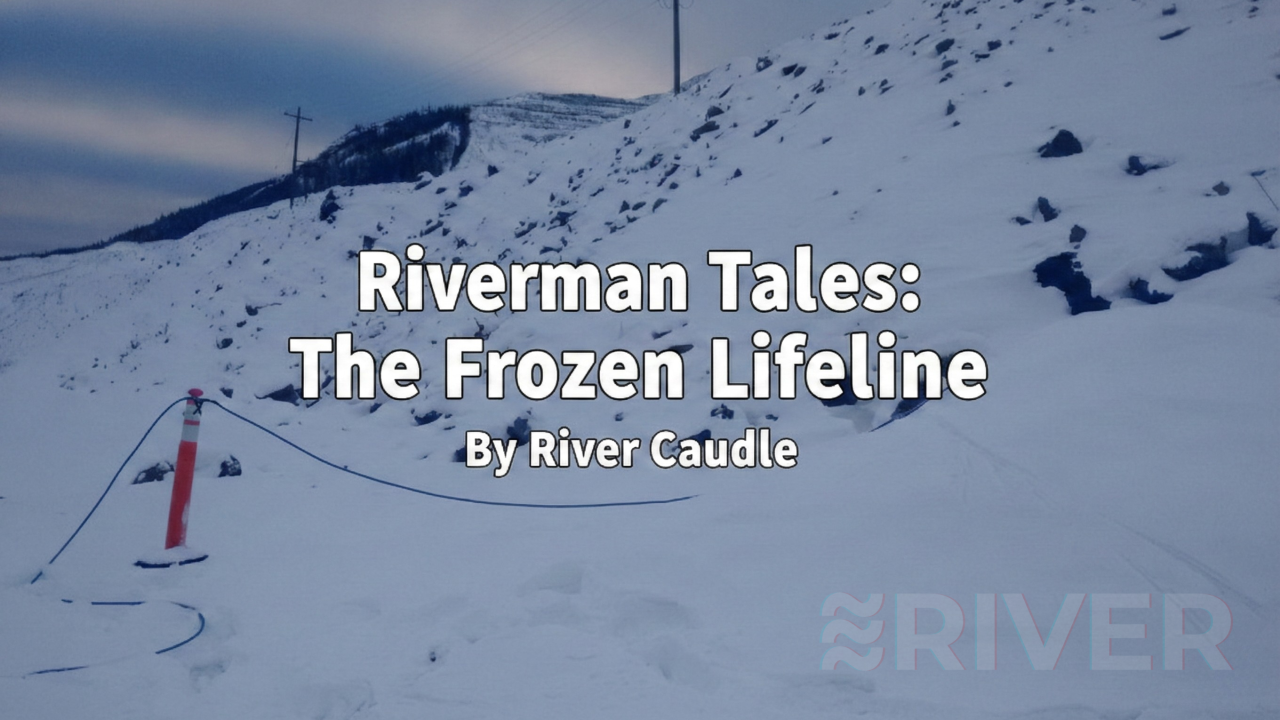
If you look at the photo attached to this post, you’ll see a blue line cutting across the snow. To a standard network architect sitting in a climate-controlled office in Birmingham or Calgary, that blue line is a violation. It’s a messy, temporary, non-compliant run of Ethernet cable strung up on a pylon and disappearing over a snowbank.
But to me, and to the guys running the tire shop at that mine, that blue line was the difference between a prison sentence and a job.
The Hershey’s Kiss
This was back in my early days in the Canadian mountains. We were operating in 20 hours of darkness a day. The client was remote enough that they had to bring civilization with them, including a franchise tire shop (think Goodyear, but darker) that operated right on the mine site.
They worked out of this giant inflatable structure shaped like a massive Hershey’s Kiss. Inside, they were wrestling 10-foot-tall tires onto Caterpillar 793 haul trucks. This is high-stakes, dangerous work. If a tire blows at the wrong time, people die. If a tire isn't replaced fast enough, production stops.
And to keep that shop running, they needed two things:
- Invoices (so the business works).
- Phones (so the humans work).
The Failure of "Enterprise Grade"
When I arrived, the connectivity to the tire shop was handled by a Cisco Wireless shot connecting to another building a few hundred meters away. Specifically, the Aironet 1310 bridges.
On paper, these were solid. In reality, they hated the environment. Between the dirty power fluctuating off the generators, the extreme cold, and the RF interference of a heavy industrial site, they were flaky at best.
I spent my first month troubleshooting that bridge night and day. I did everything a young, responsible network administrator is supposed to do. I opened TAC cases. I escalated tickets. I checked logs. I waited for the home office in Alabama to approve a solution.
Their solution? "We need to trench fiber."
Great idea. Except it was December in Northern Canada. The ground was frozen harder than concrete. We wouldn't be able to put a shovel in the dirt until April.
The Cost of Silence
Meanwhile, the bridge would die. The tire shop would go dark.
The guys in the shop would stop working. At the time, I thought they were just being difficult, taking a stand because they couldn't print work orders. Looking back, I realize it was deeper than that.
When you are working a 14-day rotation in the dark, freezing your hands off on a haul truck, the only tether you have to sanity is the ability to pick up the phone and call your "old lady." You need to hear a voice that isn't screaming over a radio.
When the internet died, that tether snapped.
The Field Repair
I realized that "following the process" was failing. The grand plan for fiber was perfect, but it was four months away. We needed a solution for now.
So, I stopped waiting.

I grabbed a spool of armored Ethernet cable. I ran 100 meters of it out the door, through the snow, down to an intermediate shack. I put a relay switch in that shack to boost the signal. Then I ran another 70 or 80 meters of armored cable from there to the tire shop electrical room.
It was ugly. It was strung up on the pylons you see in the photo to keep it visible. It got snagged by the grader clearing snow more than once, and I had to go out there in the blizzard and splice it back together.
But it worked.
The Technical Pivot
That job changed how I viewed infrastructure. I realized later that those Cisco bridges weren't just dying from the cold. They were being murdered by dirty power. They were likely sitting on the same transformer as a wash plant, thrashing the sine wave every time a heavy load kicked on.
That failure is why, to this day, I stopped trusting mains power for critical edge gear. I started specifying dual online conversion UPS units or, better yet, pure DC power systems that isolate the equipment from the grid. You can’t build a reliable network on unreliable electrons, especially in the North.

The Human Lesson
But the deeper lesson wasn't about power conditioning.
We often get obsessed with the perfect architecture, focusing on the IEC 62443 compliance, the clean fiber runs, and the redundant rings. Those things are critical.
But technology is always in service of the people and the process. In this world, making it work is generally better than making it right. This can be a trap, of course. It is not an excuse or permission to do sloppy work. But it is the reality of making it work until you can make it right.
That cable provided the invoices that kept the business profitable, yes. But more importantly, it provided the phone calls that kept the crew human.
Remember, the reason we serve is people. The technology is merely the tool.
🌊